Power bank sharing franchise or your own route: what actually differs
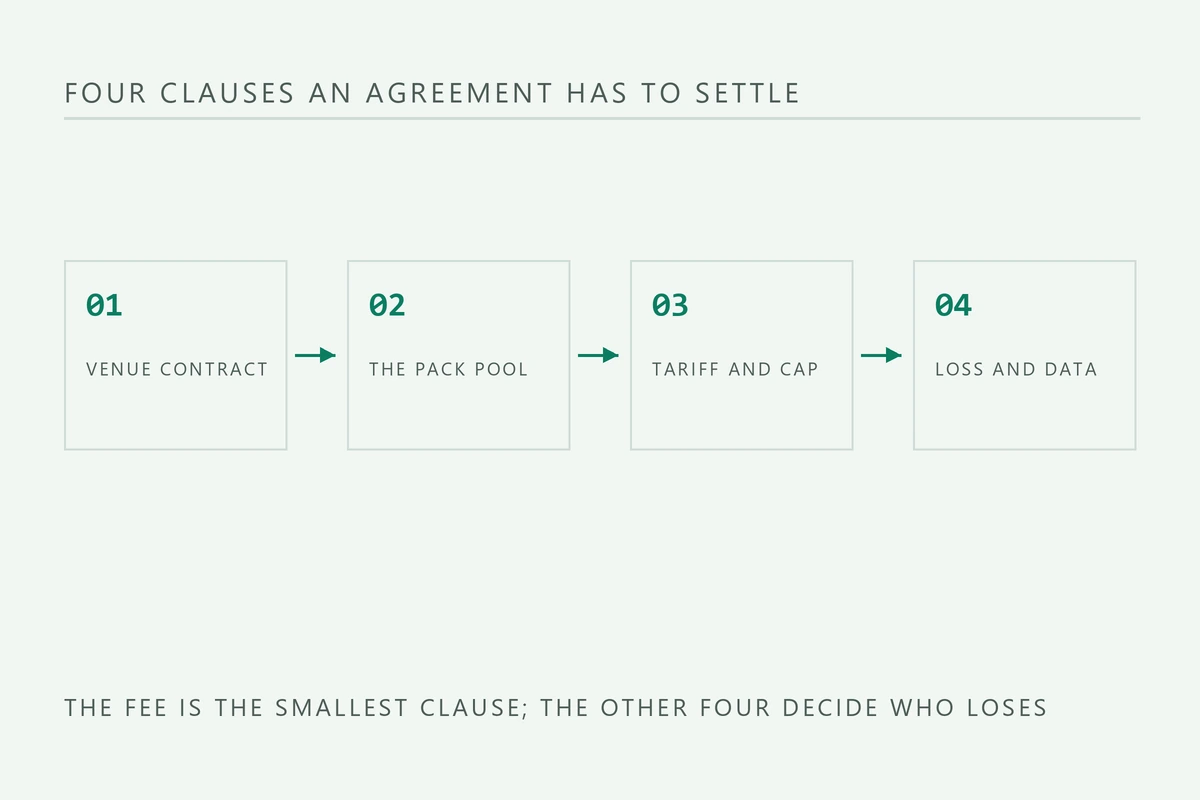
The two models sell the same rental to the same guest, from a cabinet that looks identical. What separates them is not the hardware but four clauses: who holds the venue contract, who owns the packs, who sets the tariff and who carries a lost pack. Read an agreement against those four and the choice for a first site is usually clear.
Same station, two ways to pay for it
In one model you buy the cabinets, sign with the venues and run the route. In the other, a brand, a software licence, a supply arrangement and a route design arrive as a package, and the fee buys access to that package. Both are legitimate, and both are operated by people who are good at the venue side and not interested in being a hardware importer. The failure mode is choosing by the headline fee instead of by the four clauses underneath it.
There is a third shape worth knowing before the comparison starts: buying an existing route from an operator who is leaving the market. That is neither of the two above, and it is usually the fastest way to a working venue list, provided the cabinets are still supported and the venue contracts are assignable.
The four clauses that decide the economics
Write these four on one page and put the two agreements next to each other. The model that looks cheaper on the first line is often the more expensive one on the second.
| Clause | Owned route | Licensed model | What to check |
|---|---|---|---|
| Venue contract | You sign with the venue | Often signed by the operator | Who the venue calls when a cabinet is empty |
| Pack pool | You buy and replace packs | Supplied, or paid per pack | Who pays for a lost or dead pack |
| Tariff and cap | You set both | A floor and a cap are set for you | Whether you can discount a quiet site |
| Loss and data | You carry the loss, you own the data | Shared, data may sit with the operator | Whether the history exports when you leave |
Where the licensed model earns its fee
A licence buys three things that are hard to build alone: a brand a venue manager already recognises, a back office that has been run on other sites, and a supply route for packs and spare parts. In a market where you have no venue relationships yet, the first of those is worth real money, because it shortens the conversation at the counter. The second is worth more than it looks, since the software is where a route stops being a set of phone calls.
Check what the fee does not include before comparing it to the cost of buying cabinets yourself. Training, signage, the payment setup and the first spare packs are the four lines most often quoted separately.
Where owning the route wins
If you already have the venues, the fee buys less. A bar owner who knows you will take a cabinet because you asked, not because of a brand on the screen. Owning the route also means you can mix formats freely: a counter unit where the space is small, an 8 slot station where the queue is, a 24 slot cabinet in a lobby, all on one ledger and one spare pack pool.
Ownership also puts the data in your hands, which matters at the point you sell the route or borrow against it. A rented dashboard is not an asset.
The cost of owning is front loaded: the cabinets, the first pack pool, the freight and the customs bill all land before the first rental. That is the real comparison against a licence fee, which spreads the same amount over the term and adds a margin. Neither structure removes the venue risk, and neither one makes a quiet site busy.
Questions that expose a weak agreement
- Who owns the packs, and who pays when a guest never returns one?
- Can you add a station outside the protected area, and who decides what the area is?
- What is the notice period, and what happens to the cabinets when it ends?
- Who sets the tariff after year one, and can it be changed without your agreement?
- Can you export the rental history and the venue list in a usable format?
Write the answers down and date them. A clause that exists only in a sales conversation is not a clause, and the version of the agreement that matters is the one signed before the first cabinet is ordered, not the one promised after it.
What a supplier has to answer either way
Whether the route is licensed or owned, the hardware questions are the same ones, and they belong in the enquiry before the model is chosen: the slot count that fits the peak hour, the start method the guests will accept, the circuit the cabinet needs, and the spare part list with prices. A supplier who can answer those four has answered the part that a licence cannot fix.
A franchise fee is a payment for a system, not a guarantee of a site. The venue is still the thing that decides whether a cabinet earns, and no agreement can put guests in front of it.
Updated 2026-10-24 路 4 min read. Specifications and tariffs change without notice; confirm the current sheet before you publish a business plan or a tender document.
Builds this guide applies to
The second level build pages where these decisions turn into a specification.
Questions that come back
Short answers, before the email.
Is a power bank sharing franchise better than buying stations directly?
It depends on what you already have. With venue relationships and an importer, the licence buys little. Without either, the brand and the back office can shorten the first year by more than the fee costs, provided the four clauses are written down.
Who owns the packs in a licensed model?
It varies, and it is the clause that decides who carries the loss. Get the answer in writing, including what happens to a pack that a guest keeps, because that is the cost that quietly eats a route.
Can I switch from a licence to owning the stations later?
Usually yes, and the time to check is before signing. Ask whether the termination terms let you keep the venue list and the rental history, and whether the cabinets can be moved to another software platform.
Send the venue, get the configuration.
Build, slot count and the specification sheet for each line item, in one reply.